Showing posts with label beverly hills. Show all posts

Tuesday, March 6, 2012

Dr. Raj Featured on Dime Q&A: Expert Surgeon Talks Manu Ginobili & Hand Injuries


Seeing players go down such as Zach Randolph and Al Horford, whether we will see if Manu Ginobilib will play when he comes back. Dime Q&A sat me down for my personal expertise on the breakdown on some of the game's most important injuries.


Check out the full article here!

Dr. Raj Featured on Dime Q&A: Expert Surgeon Talks Zach Randolph & Knee Injuries

Dime Q&A sat me down to see what my personal expertise was on the situation of Zack Randolph MCL Tear and and Steve Nash's Back Problem.


Check out the full article  here!

Friday, February 17, 2012

Dr. Raj Featured on The Jewish Exponent: THIGHS MATTER!

In my latest media coverage, The Jewish Exponent asked for my intake on how thighs matter.


I support the philosophy of consuming five or six small meals a day that incorporate complex carbs from grown foods, such as kale, Brussels sprouts or broccoli, as they are loaded with antioxidants and fiber.

"Though fashion has periodically glorified the slender, delicate leg and adorned it with sky-high stiletto shoes and skinny jeans for women, the findings of one recent study in Denmark suggest that bigger may actually be better when it comes to body types that include thicker thighs."

"And that goes for men, too."


Read the full article here!

Tuesday, February 14, 2012

Is De-Conditioning More Toxic Than Arthritis?

Dr. Bal Rajagopalan - known as Dr. Raj to his patients and friends – is a double board certified orthopaedic surgeon, who, in his ten years of sub-specializing in hip and knee surgery, has won a wall-full of awards.  Recognized as one of America’s top orthopedists in 2007, 2009, 2010 and 2011, he was named America’s top doctor in 2011 by United Airlines Hemispheres Magazine and featured in the publication Best of LA.  . 

It does not hurt that he is a fanatic about exercise and has bulging muscles and a six-pack usually seen only on movie stars. TV viewers have seen him as a media expert in productions on Spike TV, The Doctors, MSNBC, CBS and FOX and read about him in Newsweek.

So who is this guy?  He is a young man on a mission.  As CEO of the Beverly Hills Orthopaedic Institute Raj sees about 500 patients a month and has performed 4,000 surgical cases, mostly hips and knees, in the past ten years. He is convinced, as he told OTW, that “people are being destroyed by our society.”  The issues are obesity and self-inflicted de-conditioning. . 

The majority of Dr. Raj’s patients are between the ages of 20 and 50, which may reflect the youth-obsessed culture of Southern California.  Twenty years ago, he noted, fast foods had 30% fewer calories, kids played sports out of doors, they walked to school two or more miles – which was a given.   Now he is seeing a whole generation of youth coming into the work force who are de-conditioned. “They have no muscle support for their joints or their backs and they are obese. With their extra weight they are loading their joints and their backs and, when they go to work, they are taking jobs that are desk-bound.  I am seeing more and more young adults in their 20s coming in with injuries and issues – low back pain, knee pain, simply because of the way they have abused their bodies,” he said.

Raj’s concern is focused on two groups.  The first are those he calls “weekend warriors” - individuals who, when they were 20 could perform an exercise.  Now that they are 40, though they have not worked out for the past three years, in their heads they still think of themselves as being athletes – often with disastrous results.

 The second group is the 66% of American children who are overweight.  They are not obese, he notes, but they are overweight and, because of that, “their bodies are unhealthy.”

Raj’s weekend warriors attempt extreme exercise without consulting a physician first, do not bother with a warm-up routine, perform the exercises with improper technique and do not stop when their bodies complain. “Poor training practices, improper equipment and technique, lack of conditioning and insufficient warm-up can land a well-intentioned person in traction,” he says.

What are weekend warriors doing wrong?  Raj says that the simplest thing that most people do wrong when they want to start an exercise regime is they don’t stretch. ”They have not worked out for a week or two weeks. Their muscles are tight. Their tendons are tight. Their blood supply is not around the joints. The exerciser should spend five to ten minutes stretching. It increases blood supply; it increases flexibility of the joints – all of which prevent injury.”

He said that patients also come in with “silly” injuries that happened because of their own negligence. One example, he said, is yoga. “Ten years ago yoga was meant for yogis – people who were interested in meditation, relaxation and stretching.  Now yoga has become a true sport.  We have people who are 50 years old, people who have bulges in the discs of their necks, attempting head stands.  People who have unstable shoulders are trying to do shoulder stands.  Out of shape people assume that because yoga is slow, because it involves slow twitch muscle fibers that they should be able to keep up.”

Raj is a crusader for change. “My task is to help people who are damaging their bodies without realizing it.”  He does not blame the victims, insisting that “it is our society that is creating the problem.”  Society is becoming more and more advanced technologically “but it is destroying us,” he says.  “We have an inactive population, combined with all of these environmentally facts that contribute to the de-conditioning of muscles, increased weight on joints which leads to more and more morbidity.

“Each extra pound of weight is seven pounds of joint reactive force on your knees. So if you are ten pounds overweight that is an extra 70 pounds of force on your joints.  Imagine living to 100 years old (which many will do) and having 50 medical problems that you had struggled with all of your life.  That is going to be horrible.”

No matter ones age, exercise is vital, he says. “Exercise helps maintain range of motion in the joints and stimulates the production of joint lubrication which decreases wear and tear on your joints.”  He advises listening to your body and paying attention to it. “If you have acute pain when you are exercising, your body is telling you something is not right.” He notes that there are two types of pain. One is a work-out pain, which is deep and dull.  That is probably all right. But a sudden, sharp pain indicates that something –probably not good – has happened.

Raj, with his friend gym owner Jack Rosenbaum, has started a health and fitness program for school-age children. “We take kids with issues of self esteem, obesity and secondary pain and mentor them over a period of three months. We tell them that obesity and de-conditioning is not a socio-economic disease.  We take them to the grocery store and \show them foods that are cheaper than McDonalds and much healthier.”  Raj says that “the kids are responding. We are speaking to bigger forums and getting a lot of interest from medical practitioners.”

Raj notes that this will be the first time in history that parents will bury their children due to disease and ill health. Type 2 diabetes in children is at an all time high and children have never been unhealthier than they are right now, he says.  

Raj is enthusiastic about the promise of stem cells. “I think it is an incredible technology and we are coming close to hitting a gold mine with this.”  He is especially interested in the use of stem cells in combination with platelet rich plasma (PRP) which acts as an “igniter” when injected into a joint to promote healing of defects in the cartilage. “There is a degree in which we can make a change with stem cells,” he says.  “But we will not be able to inject stem cells and convert a full arthritic end stage to a normal knee.  That is not going to happen.”   

This crusader was born and reared in Lunenburg, Nova Scotia, a small Atlantic fishing community. Athletic and active in sports he suffered sports related injuries and as a result became acquainted with local orthopedists. “I was one of those kids who was active all the time.  I had a desire to use my hands in a way that I could help people.  When I decided to become a doctor I thought there was no better field than orthopaedics where I could combine my love of sports with the desire to help people.  The nice thing about orthopaedics is we are dealing with people who are basically healthy.  They have issues with a joint or a muscle or a tendon and we have the ability to correct that issue.  There are not many fields in medicine where a doctor can say with 100% confidence that I can correct this issue and get you well.”

Raj is a Fellow of the American Academy of Orthopaedic Surgery is Board Certified by the American Board of Orthopaedic Surgery and certified by the Royal College of Orthopaedic Surgery of Canada.  He and his wife, who is a child psychiatrist at UCLA, have a three-year-old child.

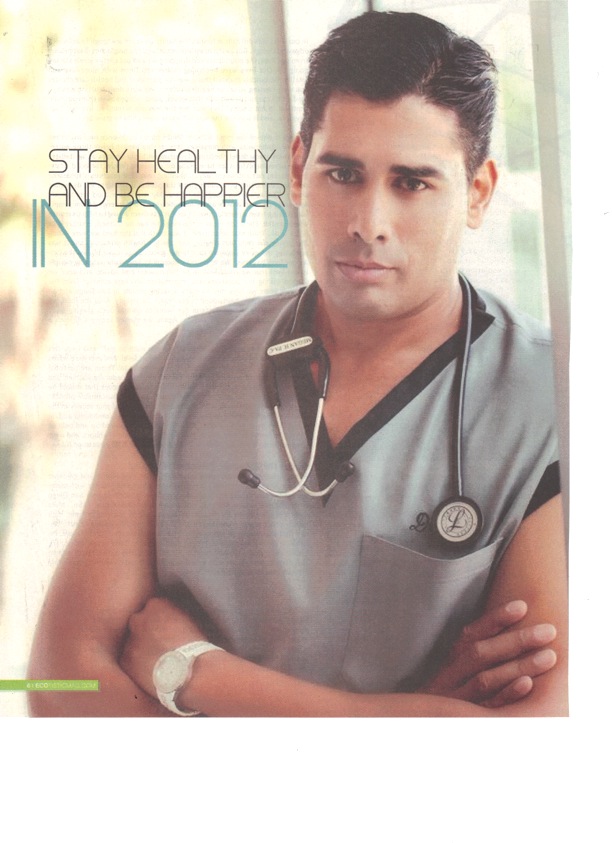
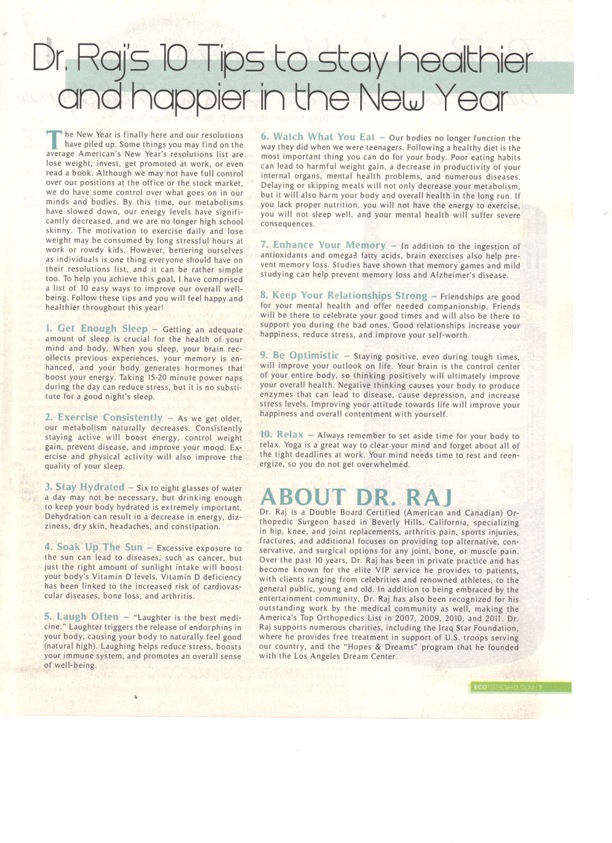
Dr. Raj Featured on ECOTISTIC Magazine: 10 Tips To Stay Healthier And Happier In The New Year

Ecotistic Magazine asked for my help on composing a list to stay healthier and happier in the new 2012 year. Check out the article below!


Dr. Raj Featured on GirlsGoneSporty: Preventing women's knee injuries!

In my latest media, GirlsGoneSporty asked for my professional advice on preventing women knee injuries.


Knee injuries are one of the most common sports injuries in people with active lifestyles. The types of knee injuries most people face are ACL, MCL, and PCL injuries, twisting or stretching injuries, and torn cartilage. Although both men and women experience knee injuries, active women are two to eight times more likely than men to have certain types of knee problems, like tears of the ACL and non-contact injuries.


Check out the full article here!

Monday, October 10, 2011

AN EXERCISE IN ORTHOPEDICS: Dr. Raj Discusses the Angel Out for the Season

Mark Trumbo is known for playing an infielder position for a Major League Baseball team-- the Los Angeles Angels of Anaheim.  He plays right infield and first baseman. 


At only 25 years old, he is a leading contender for the American League Rookie of the Year Award.


For about a month and a half, Mark had been playing several games with pain in his right foot. On Monday, September 26th, 2011, after several tests- including MRIs, CT scan, and x-rays, the team orthopedist discovered a stress fracture at the top of his right foot in the navicular bone. 


No surgery is indicated for Mark but he will need to rest his foot for the rest of the season. He will be placed in a walking boot with no vigorous activity for at least 6 weeks.


The Breakdown
A stress fracture is one of the most common causes of foot pain. A metatarsal stress fracture is also called a “March fracture” because pain increases with activity specifically seen in solider recruits. In several interviews, Mark stated he felt throbbing pain across his right foot and felt his activity was limited.

These types of fractures need time to heal properly to avoid surgical intervention. An x-ray would have shown a hairline crack in one of the metatarsals (foot bones)-in this case the navicular bone.

Treatment includes rest for 6-8 weeks usually in a stiff orthopedic boot. Mark will be ready to return for next season as a full–time first baseman!

Wednesday, September 21, 2011

Dr. RAJ in the News: 4 Ways to Avoid Achy Joints

When it comes to health, fitness, and improving your overall quality of life, LiveRight LiveWell is an online powerhouse of helpful, informative content. And the experts within its editorial collective are each considered beyond worthy of any surgeon's ear - and respect, for that matter.

In a recent HEALTH & FITNESS article, I was asked to contribute my thoughts not only on orthopedic analysis of joint pains over time, but was also encouraged to contribute a few fitness and exercise routines to keep the creaks away.

Briefly, the article's key points are...
Listen to your Body.  Your body knows best, which is why you need to pay attention to it. If you feel sore a day or two after working out, that shouldn’t raise any red flags. “But if you have acute pain when you’re exercising, your body’s telling you something’s not right,” says Rajagopalan. Stop the activity and see a doctor if the pain persists.
Cross-Train.  The best way to keep doing the activities you love is to vary what you do. “I never tell people they have to quit their favorite activities just because they’re getting older,” says Rajagopalan. Of course, if you’re having pain during a specific activity, that’s a different story, he adds. But if your joints aren’t protesting and you love playing tennis, for example, try alternating with hiking or yoga. “By cross-training, you work different muscles and avoid putting repetitive stress on the body, which can lead to injury,” he says.
Vary your Impact.  High-impact activities, like running and playing tennis, place a lot of stress on your body -- especially your joints -- whereas low-impact activities like walking, cycling and Pilates place little stress on the body. In fact, people in the above study who did light exercise, like walking, had the healthiest knee cartilage. So if you’re always doing high-impact activities, then give your body a break and swap in some low-impact activities a few times a week.
Modify your Routine.  Tough as it is to accept, there may come a day when injury forces you to give up an activity, perhaps even permanently. But don’t despair. This doesn’t mean you’re completely sidelined. Work with your doctor to come up with alternatives, advises Rajagopalan. For instance, if running is taking too big a toll on your knees, then try taking it down a notch and walk or use an elliptical machine instead. By finding similar, more joint-friendly activities, you can respect your body, avoid achy joints and still enjoy the benefits of a healthy, active lifestyle at every age.
The coverage has been quite impressive, and to all who shared, including several regional FOX and MSNBC networks, I am most humbled and grateful.

To read the original article by well-known Health & Fitness wordsmith Karen Asp, click here...

Sunday, September 4, 2011

AN EXERCISE IN ORTHOPEDICS: British Star Rocks Boot at VMAs

Co-written by Gina Sacco Pac

Jessica Ellen Cornish, better known by her stage name - Jessie J - is an R&B and soul artist from the UK, who rocked the stage as the house band at the annual MTV Video Music Awards in Los Angeles on Sunday, August 28th.


Just breaking into the music scene in the US, Jessie J is currently at the top of the UK singles charts.  During the show, Jessie J gave the performance while sitting down with a decorated cam boot. The audience can also see her being interviewed leaning on glittery crutches.
           
In June, Jessie J was at rehearsal for an upcoming show when she got injured. Unfortunately, during a dance routine, she fell off the stage and fractured her foot and ankle- in two places.

The Breakdown from DR. RAJ

The fracture was severe enough to require surgery, which she had a week later. After surgery, she sports the cam boot and crutches that VMA viewers saw on Sunday.

Fractures of the feet can range in severity. In most cases, they do not require surgery-- only rest. However, in Jessie J’s case, the bones were severely out of place and in an area of poor blood supply, where surgery was needed. Afterwards, a non-weight bearing cast will be used for more than a month to aid the healing process.

The injury certainly didn’t stop this rising star though- she continues to perform all her shows sitting on gold thrones, and not disappointing her fans!

Monday, August 22, 2011

AN EXERCISE IN ORTHOPEDICS: Drew Carey Injures Collarbone

Although a comedian well-known for a variety of shows, Drew Carey currently hosts the famous game show, The Price is Right. And while he thinks nobody can replace Bob Barker, he took over his role in 2007 and continues to make audiences laugh with his variety of successful TV and comedy show appearances.


According to Drew’s Twitter account on Tuesday, August 16th, he injured his collarbone when he fell during a morning jog.  He went to a local hospital to be x-rayed. The x-ray showed a separated clavicle. Unfortunately, Drew had to cancel the game show taping for the day. He reported that all his injury will need is time to heal and plenty of ice. In this case, no surgery is needed.

The Breakdown

A separation of the shoulder occurs when the collarbone (clavicle) separates from the shoulder joint (acromioclavicaular joint) and shoulder blade (scalpula). One of the most common ways for this injury to happen is falling on an outstretched hand. Drew most likely felt severe pain, swelling, and bruising.

The Recovery i$ Right!

There are six grades of shoulder separations depending on the degree of severity.  Type I and II only require conservative care including rest (sometimes with a sling), oral anti-inflammatory medications and ice every 4 hours for a period of 15 minutes. This should be done for several days until the swelling around the joint subsides.


Surgical repair is required in the more severe types where the ligaments need to be reconstructed to hold the top of the shoulder in place or stabilize the clavicle. Luckily in Drew’s situation, he was back to hosting the game show the following day!

Monday, August 8, 2011

New Feature in DIME Magazine: Yao Ming Q&A with Dr. RAJ

In my latest media coverage, Dime Magazine sat me down for a Q&A, talking about Yao Ming's foot and ankle injuries that never quite healed.


The article also discusses common orthopedic problems of larger athletes - and how today's fast-growing, athletic youth can prevent this type of sports quandary in the long run.

Read the full article here...

Thursday, August 4, 2011

Dr. Raj in GLOBE Magazine's Alex Trebek Feature!

In my last post, we discussed the details of Alex Trebek's recent injury, the breakdown of its cause, and his next steps to...what is, recovery? And apparently, the talented editorial crew at GLOBE Magazine took notice.


Wednesday, August 3, 2011

AN EXERCISE IN ORTHOPEDICS: Trebek's Achilles Tendon in Jeopardy

George Alexander "Alex" Trebek, the nation's renown host of hit game show Jeopardy! since 1984, has been awarded multiple Emmy awards and earned his star on Hollywood's walk of fame.


On July 27th, Alex was hosting a world championship in San Francisco when his hotel room was robbed. While chasing the burglar down the hallway, he felt a snap in his heel. He was only able to limp back to the room since he ruptured his Achilles tendon. 


He was able to call security and the robber was charged with a felony burglary and stolen property. She got away with some cash and jewelry from his mother. Alex is expected to undergo surgery this week to repair the tendon. He will be in a cast for 6 weeks after.


The Breakdown


The strong fibrous chord in the back of the heel is called the Achilles tendon. It connects the muscles in the back of the calf to the heel bone. If this tendon is overstretched, patients will feel and hear a snap with immediate pain. Other common symptoms of an Achilles tendon rupture include swelling over the heel, unable to stand up on the toes and push off with the injured foot to walk. 


What is...Alex's Recovery?


An MRI may be ordered to determine the extent of the tendon tear. Surgical repair of the tendon is the most common treatment for a complete rupture. Alex will undergo this procedure where the torn tendon is stitched back together. Afterwards for 6-8 weeks, a cast or walking boot would be used. 


Physical therapy will also be implemented Post-Operatively to strengthen the leg muscles and tendon. Alex will return to hosting in no time!

Tuesday, August 2, 2011

NEW Feature in EverydayHealth.com

EverydayHealth.com is a fantastic resource for health, fitness, and all-around better living - which is why I was honored to have been contacted by them for an interview.

Everyday Health


In this feature, Everyday Health talks to authorities on health and wellness to uncover their real-life habits.

The article is titled "An Inside Look at How Top Nutritionists, Doctors, and Personal Trainers Eat and Exercise" and the full article can be found here. 

Wednesday, July 27, 2011

NEW Feature in Becker's Orthopedic & Spine Review!

Recently, I was contacted by Chicago medical publication Becker's Orthopedic & Spine Review, an industry-known bimonthly publication offering news and analysis on business and legal issues relating to orthopedic and spine practices.


The editorial staff was seeking top orthopedic and spine surgeons, in order to procure some insight as to whether or not for surgeon-device company relationships in the future. 


I was honored to be featured in this list of thought leaders, and felt even more privileged that an esteemed Midwest publisher contacted me - an orthopedic surgeon in Beverly Hills!


But to summarize, here is my take on the current state of surgeon relationships with device companies and what might be in store for the future...
"Spine and orthopedic surgeons used to have a much closer relationship with device companies, but because of the potential bias these relationships have changed. There have been several issues in regards to these ongoing relationships, including surgeons who have benefitted from using the implants of companies they have a relationship with. We've seen a lot of these relationships dissipate and it's to protect patients.
I think surgeons and device companies will be able to have legitimate relationships in the future and we will get rid of the illegitimate relationships. Even when the relationship is legitimate, it is the surgeon's responsibility to disclose them publicly. The recent scrutiny on these relationships is great in the sense that it is protecting people. It's cleaning up the whole scenario — there are only a few bad seeds who have led to this problem. The surgeons in legitimate relationships with companies don't have anything to worry about."

Sunday, July 24, 2011

AN EXERCISE IN ORTHOPEDICS: The Bachelorette's Leg Injury

In its Season 6, ABC’s “The Bachelorette” featured Ali Fedotowsky. 

The show, which premiered in May 2010, featured Ali on the search among 25 unique suitors to find the man of her dreams. She now has wedding plans underway with fiancé Roberto Martinez.

In June 2011, she was seen using crutches after injuring her femur while kickboxing to stay in shape.


She originally thought that a ligament in her knee was torn - and visited a specialist for a detailed examination.  The MRI showed a fracture in her femur as a result of an osteochondral defect in the cartilage. She will most likely have surgery to repair the defect.

The Breakdown

Often caused by repeated injury to the joint, an osteochondral defect (OCD) is an area of damaged cartilage in the joint. The bone underneath it may be involved as well. The knee is the most common location for this defect. 

Ali most likely experienced symptoms such as joint locking, recurrent swelling, and persistent pain.

Walking the Aisle: Next Steps

For smaller lesions, arthroscopic surgery can help to clean up the cartilage. In more severe cases, an open surgical repair may be needed with an implant and autograft.

After surgery, Ali will be back to wedding planning with her fiancé!

Saturday, July 16, 2011

AN EXERCISE IN ORTHOPEDICS: A-Rod Suffers Knee Injury

New York Yankees slugger and 3rd baseman, Alex Rodriguez is considered one of the best all-around baseball players of all time. Having hit over 600 home runs, he remains the all-time MLB leader.

In a game against the Chicago Cubs on June 19th, 2011 A-rod injured his right knee. He was sent for x-rays, which showed a small tear in the meniscus. With the injury affecting his performance, he underwent surgery in July to repair the tear.


The knee is made up of two crescent shaped cartilage menisci. A meniscus tear is commonly seen in sports where the knee is twisting or over-flexed. This cartilage is essential to providing shock absorption and even weight distribution over the joint. 

Some common symptoms A-rod would have felt include severe pain, swelling, clicking or popping, and catching or locking of the knee. Treatment depends on the extent of the tear. Small tears can be treated conservatively and with time, will heal on their own. In A-rod’s case, the tear was large enough to be repaired surgically.  

With the help of a scope, the tear can be easily trimmed back down to normal.  In just 4 to 6 weeks, A-rod should be back making big plays and hitting homers!

Friday, July 1, 2011

AN EXERCISE IN ORTHOPEDICS:Andrew Bynum Knee Injury

A player of the one of the NBA's most loved franchises, Center Andrew Bynum was drafted by the Los Angeles Lakers in 2005 - at 17 years old. And despite various injuries to his knees, his career continues to soar. 


In the second quarter of a Lakers’ game in April against the San Antonio Spurs, Andrew fell after stepping on Spurs’ DeJuan Blair’s foot.  He was then sidelined with a knee injury,  


Bynum ended up hyper-extending his knee and had to leave the game. His coach, Phil Jackson, recommended that he might need to be out for the next few games since this was not his first knee injury. 

Dr. Raj receives nomination for Haute MD's top doctors list

AN EXERCISE IN ORTHOPEDICS: Aretha Franklin Toe Fracture

Ranked at the top of Rolling Stone’s list of  "The greatest singers of all time",Aretha Franklin is famous for blessing the world with her blues, jazz and gospel tunes.

On June 21st, “The Queen of Soul” was packing in her hotel room and ended up tripping over the spike of her Jimmy Choo high-heeled shoes, injuring her left 2nd toe.  The next day she reported her toe was still in pain and throbbing. She was sent for x-rays, which revealed a fracture.